Different Types of Concrete and When to Use Them
Concrete is not a one-size-fits-all material. There are many different types of concrete, each formulated to meet specific requirements in terms of strength, workability, durability, and application. Choosing the right type of concrete for your project is essential for achieving a quality result that lasts. In this guide, we cover the most common types of concrete and explain when each one should be used.
Quick answer
The main types of concrete are standard ready-mix, high-performance, waterproof, self-compacting (Rock Flow), fibre-reinforced (Rock Fibre), lightweight, and pumped concrete. Most domestic jobs use standard ready-mix graded C20/25 to C28/35, while specialist mixes solve specific problems like awkward access, water, or cracking.

Standard Ready-Mix Concrete
Standard ready-mix concrete is the most widely used type in the UK. It is produced at a batching plant and delivered to site in a mixer, ready to pour. Ready-mix concrete is available in a range of grades that indicate its compressive strength at 28 days, measured in Newtons per square millimetre (N/mm2).
The most common grades and their typical applications include:
Ready-mix concrete is ideal for most projects because it is batched to precise specifications, ensuring consistent quality. It also saves time and labour compared to mixing concrete on site by hand.
High-Performance Concrete
High-performance concrete (HPC) is engineered to provide superior properties compared to standard mixes. It is characterised by high compressive strength (typically above C50/60), low permeability, and exceptional durability. HPC is achieved through careful selection of materials, low water-cement ratios, and the use of supplementary cementitious materials such as silica fume, fly ash, or ground granulated blast furnace slag (GGBS).
High-performance concrete is used in demanding applications such as:
- High-rise buildings and skyscrapers
- Bridges and infrastructure projects
- Marine structures exposed to salt water
- Nuclear containment structures
- Industrial floors subject to extreme wear
While HPC is more expensive than standard mixes, the improved durability and longevity often make it more cost-effective over the life of the structure.
Waterproof Concrete
Waterproof concrete, sometimes referred to as watertight or water-resistant concrete, is designed to prevent the passage of water through the concrete matrix. It achieves this through a combination of low permeability mix design and the addition of waterproofing admixtures that block the capillary pores within the hardened concrete.
Common applications for waterproof concrete include:
- Basements and below-ground structures: Where the concrete is in direct contact with groundwater and must remain dry on the interior.
- Retaining walls: Particularly those holding back waterlogged soil.
- Swimming pools and water features: Where the concrete must contain water without leaking.
- Flat roofs and balconies: Where water ingress can cause structural damage over time.
- Water treatment facilities: Where containment integrity is critical.
Waterproof concrete is often used as part of a wider waterproofing strategy that may also include membranes, drainage systems, and cavity drain systems. Proper joint detailing and construction practice are also essential for achieving a watertight structure.
Self-Compacting Concrete (Rock Flow)
Self-compacting concrete (SCC), which we supply under the name Rock Flow, is a highly fluid concrete mix that flows under its own weight and compacts without the need for mechanical vibration. It fills formwork completely, flowing around reinforcement and into tight spaces, producing a dense and uniform finish.
The key advantages of self-compacting concrete include:
- Reduced labour: No need for vibration equipment or the skilled operators to run it.
- Improved surface finish: The flowing nature of SCC produces smooth, high-quality surfaces with fewer air pockets and honeycombing.
- Faster placement: The high flowability means large pours can be completed more quickly.
- Reduced noise: Without vibrators running, the site is significantly quieter, which is beneficial in residential areas and urban environments.
- Better congestion handling: SCC flows around dense reinforcement arrangements where traditional concrete would struggle to compact fully.
Rock Flow is particularly popular for slipform, heavily reinforced sections, and any application where a smooth finish and reliable compaction are priorities. We can also add structural fibres to the mix if the application requires it.
Fibre-Reinforced Concrete (Rock Fibre)
Fibre-reinforced concrete incorporates small fibres distributed throughout the mix to improve its structural properties. We supply this product under the name Rock Fibre. The fibres can be made from steel, polypropylene, glass, or synthetic materials, and they serve to control cracking, improve impact resistance, and enhance the overall toughness of the concrete.
There are two main categories of fibre reinforcement:
Micro Fibres (Polypropylene)
These fine, short fibres are added to the mix primarily to control plastic shrinkage cracking that occurs in the first few hours after pouring. They also improve fire resistance by creating channels for steam to escape when concrete is exposed to extreme heat. Micro fibres are commonly used in floor slabs, paths, and general domestic applications.
Macro Fibres (Steel or Synthetic)
These larger fibres provide structural reinforcement and can replace or supplement traditional steel mesh or rebar in certain applications. They improve the concrete's resistance to cracking under load, enhance impact resistance, and improve post-crack performance. Macro fibres are used in industrial floors, pavements, precast elements, and shotcrete applications.
Rock Fibre can save time and money on site by reducing or eliminating the need to place and tie steel reinforcement mesh. It also provides more uniform reinforcement throughout the entire concrete section, rather than only at the level where the mesh is placed.
Lightweight Concrete
Lightweight concrete is produced by replacing some or all of the normal-weight aggregates with lightweight alternatives such as expanded clay, shale, or slate. The resulting concrete has a significantly lower density than standard mixes, typically between 300 and 1,850 kg/m3 compared to roughly 2,400 kg/m3 for normal concrete.
The reduced weight offers several advantages:
- Reduced structural loads: Lighter concrete means smaller and more economical structural members can be used.
- Improved thermal insulation: The air pockets within lightweight aggregates provide better insulation properties.
- Easier handling: Precast lightweight concrete elements are easier to transport and install.
- Sound insulation: Certain lightweight mixes offer improved acoustic properties.
Lightweight concrete is commonly used in floor screeds, roof insulation, block manufacturing, infill panels, and situations where reducing the dead load on a structure is important. It is generally not suitable for heavy structural applications due to its lower compressive strength compared to standard mixes.
Pumped Concrete
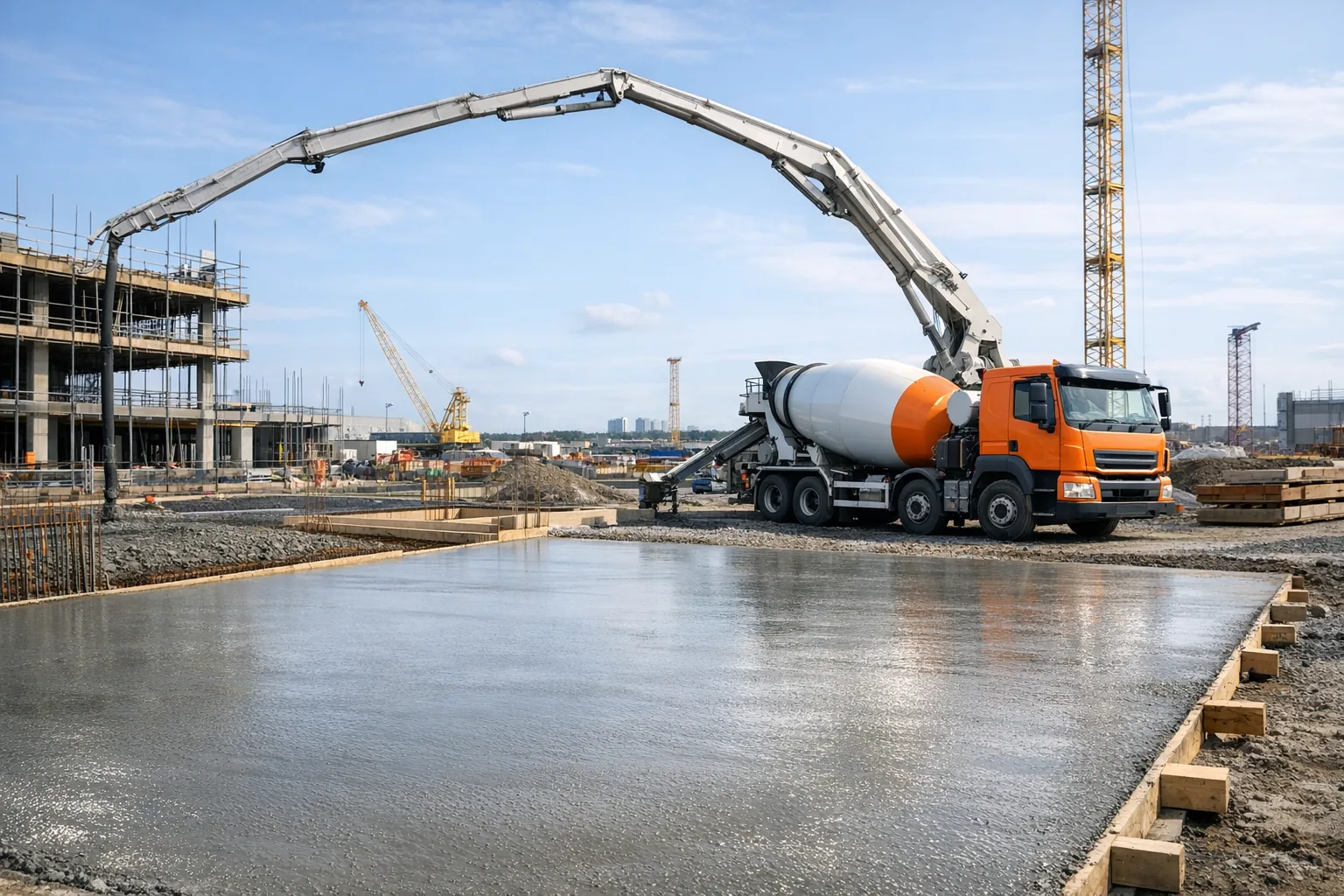
Pumped concrete is not a different type of concrete per se, but rather a method of delivering concrete to locations that are difficult to reach with a standard mixer truck. The concrete is pumped through a pipeline or boom pump directly to the point of placement, which can be at height, at a distance, or in confined spaces.
For concrete to be suitable for pumping, it must meet certain requirements:
- Appropriate slump: The mix must be fluid enough to flow through the pipeline without blocking, typically a slump of S3 or S4.
- Correct aggregate size: The maximum aggregate size must be compatible with the pipeline diameter. Smaller aggregates (10mm or 20mm) are preferred for pumping.
- Sufficient fines content: Adequate cement paste and fine material help the mix flow smoothly and prevent segregation in the pipeline.
- Pumping admixtures: Special admixtures may be added to improve pumpability without compromising the finished concrete properties.
Pumped concrete is widely used for upper-floor pours on multi-storey buildings, pours over obstacles or into areas with restricted access, large slab pours where speed of placement is important, and any project where the pour location is not directly accessible by a mixer truck.
When to Use Each Type
Selecting the right concrete type depends on your project requirements. Here is a quick reference guide:
Domestic Projects
Shed bases, paths, patios, and garden walls typically use standard ready-mix in grades C25/30 to C28/35. For driveways, consider C28/35 or C30/37.
Foundations
Strip footings and trench fill typically require C8/10 for single storey and C15/20 for double storey buildings. For deeper or more complex pours, Rock Flow (SCC) ensures complete compaction.
Floors & Slabs
Industrial and commercial floors benefit from Rock Fibre for crack control. Domestic floors can use standard ready-mix with optional polypropylene fibres.
Below Ground
Basements and retaining walls in contact with groundwater need waterproof concrete to prevent water ingress.
Restricted Access
When the mixer truck cannot reach the pour location, pumped concrete is the solution, delivering the mix through a boom or line pump.
Weight-Sensitive Structures
Where reducing dead load matters, such as upper floors or roof screeds, lightweight concrete provides strength with significantly less weight.
Types of Concrete FAQs
What are the main types of concrete?
The main types are standard ready-mix, high-performance, waterproof, self-compacting (Rock Flow), fibre-reinforced (Rock Fibre), lightweight, and pumped concrete. Most domestic projects use standard ready-mix in grades C20/25 to C28/35.
What type of concrete is best for a driveway?
A C28/35 mix is the usual choice for domestic driveways. For frost resistance an air-entrained mix such as PAV1 or PAV2 is specified. Step up to C32/40 for heavy or daily van use.
What is the difference between ready-mix and self-compacting concrete?
Standard ready-mix needs vibrating to compact. Self-compacting concrete (Rock Flow) flows under its own weight and compacts without vibration, giving a smoother finish and filling heavily reinforced or awkward forms.
Which concrete type is best for foundations?
Strip footings and trench fill typically use C8/10 for single storey and C16/20 for double storey, unless an engineer specifies higher. Self-compacting Rock Flow suits deep or congested pours.
What is fibre-reinforced concrete used for?
Fibre-reinforced concrete (Rock Fibre) adds steel or polypropylene fibres to control cracking and improve toughness. It is used in industrial and commercial floors, slabs, and pavements, often reducing or replacing steel mesh.
Not Sure Which Type You Need?
Choosing the right concrete can make or break your project. At Rock Solid Concrete, we supply a full range of concrete products from our batching plants in Coventry and Melton Mowbray, including standard ready-mix, Rock Flow, Rock Fibre, and specialist mixes. Our team is always happy to help you select the right product for your specific needs.


