How Long Does Concrete Take to Cure?
Curing is one of the most important steps in any concrete project, yet it is often overlooked. Getting the curing process right can mean the difference between concrete that lasts decades and concrete that cracks, crumbles, or fails prematurely. In this guide, we break down everything you need to know about how long concrete takes to cure and how to ensure the best results.
Quick answer
Concrete reaches about 70 percent of its strength in 7 days and its full design strength at 28 days. You can usually walk on it after 24 to 48 hours, drive a car on it after 7 days, and run heavy vehicles on it after 28 days. Keeping it moist for the first week is the single most important step.
What Is Concrete Curing?
Concrete curing is the process by which freshly poured concrete gains strength and hardens over time. It is not simply a matter of the concrete "drying out." Instead, curing is a chemical reaction called hydration, where the cement in the mix reacts with water to form strong crystalline bonds.
For hydration to occur properly, the concrete needs to retain sufficient moisture and remain at a suitable temperature. If the concrete dries out too quickly or is exposed to extreme temperatures, the hydration process is disrupted, leading to weaker concrete with a higher risk of surface cracking and reduced durability.
Curing is not the same as setting. Setting is the first few hours when concrete stiffens and becomes solid, whereas curing is the longer process that builds strength over days and weeks. If you specifically want initial set and finishing times, read our guide on how long concrete takes to set.
How Long Does Concrete Take to Cure?
Concrete cures over 28 days. It gains strength quickly at first and then more slowly: roughly 70 percent of its final strength develops in the first 7 days, with the remainder building up to the 28 day benchmark. The timeline is usually broken into several key stages:
Initial Set
Within the first 24 to 48 hours, concrete undergoes its initial set. During this period the concrete transitions from a plastic, workable state to a solid form. By around 24 hours, the surface is usually firm enough to walk on carefully, though the concrete is still far from full strength.
Approximately 70% Strength
After seven days of proper curing, most concrete mixes will have reached roughly 70% of their designed compressive strength. At this stage, formwork can typically be removed and light loads can be applied. Many construction schedules are planned around this seven-day milestone.
Full Design Strength
The industry standard for concrete reaching its full design strength is 28 days. If cube testing samples were taken during the pour, this is when they are crushed to confirm that the mix meets its specified compressive strength, whether that is C20, C30, C40, or another grade. While concrete continues to gain strength slowly beyond 28 days, this point is considered the benchmark.

Factors That Affect Curing Time
Several factors can speed up or slow down the curing process. Understanding these will help you plan your project and avoid common pitfalls.
Temperature
Temperature has a significant impact on curing. In warm conditions (above 20 degrees Celsius), the hydration process accelerates and concrete gains strength more quickly. However, if it is too hot, the surface can dry out faster than the interior, causing shrinkage cracks. In cold weather (below 5 degrees Celsius), curing slows dramatically. If concrete freezes before it has gained sufficient strength, the ice crystals that form can permanently damage the internal structure, leading to surface scaling and reduced strength.
Humidity and Moisture
Concrete needs moisture to cure properly. In dry or windy conditions, water evaporates from the surface too quickly, starving the hydration reaction. This is why keeping concrete moist during the first few days is so important. High humidity conditions are actually beneficial for curing, as they reduce the rate of moisture loss.
Mix Design
The specific concrete mix plays a role in curing time. Mixes with a higher cement content generally gain strength faster. Additives such as accelerators can speed up the setting time, while retarders can slow it down. The type of cement used also matters: rapid-setting cements reach early strength much faster than standard Portland cement. Our guide to concrete mix grades explains how different grades behave.
Water-Cement Ratio
The ratio of water to cement in the mix affects both workability and final strength. A lower water-cement ratio produces stronger concrete but is harder to work with. Too much water makes the mix easier to pour but dilutes the cement paste, resulting in weaker concrete and a longer path to full strength.
Section Thickness
Thicker concrete sections retain heat and moisture for longer, which can aid the curing process. However, in very thick pours, the heat generated by hydration can build up excessively (known as thermal cracking), which requires special measures to control.
Tips for Proper Curing
Taking the right steps during the curing period will help ensure your concrete reaches its full potential. Here are the key practices to follow:
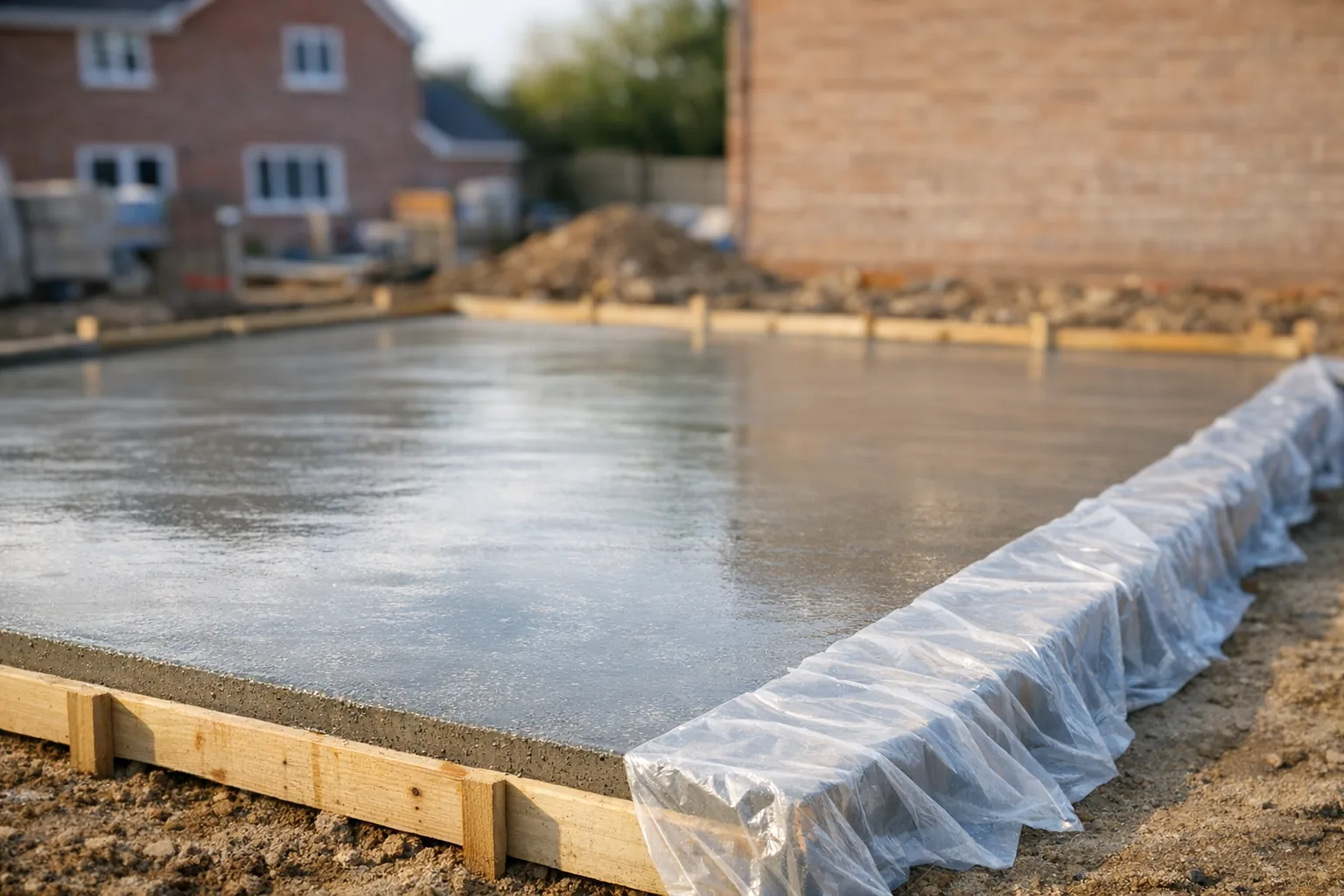
- Keep it moist: For the first seven days after pouring, keep the concrete surface damp. You can do this by spraying it with water regularly, covering it with wet hessian, or using plastic sheeting to trap moisture.
- Avoid freezing: If temperatures are expected to drop below freezing, protect fresh concrete with insulating blankets or heated enclosures. Never pour concrete onto frozen ground without taking precautions.
- Use curing compounds: Best used for particularly wet mixes such as self-compacting concrete, liquid curing compounds can be sprayed onto the surface to form a membrane that retains moisture. These are particularly useful on large slabs or in situations where regular watering is not practical.
- Protect from direct sun and wind: On hot or windy days, use shade structures or windbreaks to reduce the rate of evaporation from the surface.
- Do not overwork the surface: Excessive trowelling or finishing can seal the surface prematurely, trapping bleed water and leading to delamination or scaling later on.
- Avoid loading too early: Resist the temptation to put heavy loads on concrete before it has gained sufficient strength. Follow the recommended timelines for your specific mix grade.
When Can You Walk or Drive on New Concrete?
One of the most common questions we receive is about when new concrete is safe to use. Here are the general guidelines:
Foot Traffic
Light foot traffic is generally safe after 24 to 48 hours, depending on the mix and conditions. Avoid dragging heavy objects across the surface during this period.
Light Vehicles
For cars and light vehicles, it is best to wait at least 7 days before driving on a new concrete surface. This allows the concrete to reach approximately 70% of its design strength.
Heavy Vehicles & Equipment
Heavy vehicles, skips, and construction equipment should be kept off new concrete for at least 28 days, or until the concrete has reached its full design strength.
These are general guidelines. The actual times can vary depending on the concrete grade, weather conditions, and the thickness of the pour. If in doubt, speak to our team for advice tailored to your project.
Concrete Curing Time FAQs
How long does concrete take to cure?
Concrete reaches around 70 percent of its strength after 7 days and its full design strength after 28 days. It is usually firm enough for light foot traffic within 24 to 48 hours, but heavy loads should wait until the 28 day mark.
What is the minimum curing period for concrete?
The minimum curing period for most structural concrete is 7 days of moist curing in normal conditions. In cold weather, or for mixes with slower strength gain, this can extend to 10 days or more. Curing for the full 28 days gives the best durability.
Is curing the same as concrete setting or drying?
No. Setting is the first few hours when concrete stiffens from a liquid into a solid. Drying is moisture leaving the surface. Curing is the controlled hydration that builds long term strength over days and weeks, which is why concrete must be kept moist rather than allowed to dry out.
How long before you can walk or drive on new concrete?
Light foot traffic is generally safe after 24 to 48 hours. Wait at least 7 days before driving cars or light vehicles onto a new slab, and at least 28 days before allowing heavy vehicles, skips, or construction plant.
Do concrete beams and columns cure at the same rate as slabs?
Beams, columns, and slabs all follow the same 28 day strength curve, but thicker sections such as columns retain heat and moisture for longer, which can aid curing. Formwork is usually struck once the element reaches around 70 percent strength, typically after 7 days.
Can you speed up concrete curing?
You can support faster early strength with rapid setting cements, accelerator admixtures, warm conditions, and good moisture retention. You cannot safely rush the full 28 day strength gain. Forcing concrete to dry too quickly weakens it and risks surface cracking.
Does cold weather affect curing time?
Yes. Below about 5 degrees Celsius hydration slows sharply, and freezing fresh concrete can permanently damage it. In winter, protect the pour with insulation and allow longer before loading. See our winter concrete pouring guide for the full set of precautions.
Get the Right Concrete for Your Project
At Rock Solid Concrete, we supply a wide range of ready-mix concrete from our batching plants in Coventry and Melton Mowbray. Whether you need a standard mix for a shed base or a high-strength grade for foundations, our team can help you choose the right product and advise on curing best practices.